
Autism Disclosure in the Workplace: What Employers Need to Know

For many autistic employees, deciding whether to disclose their diagnosis at work is not a straightforward decision. While disclosure can lead to understanding, support, and workplace accommodations, it can also expose individuals to stigma, misunderstandings, and concerns about how colleagues or managers may perceive them.
As organizations increasingly invest in diversity, equity, and inclusion (DEI), understanding the realities of autism disclosure is an important part of building genuinely inclusive workplaces.
Why Do Employees Hesitate to Disclose Autism at Work?
Research suggests that the greatest concern for autistic employees is not the diagnosis itself, but how disclosure might affect the attitudes and behaviour of others in the workplace.
Many autistic professionals carefully weigh the potential benefits of disclosure against the potential costs. Questions they may ask themselves include:
Will my manager view me differently?
Will colleagues make assumptions about my capabilities?
Will disclosure affect my career progression?
Will I receive meaningful support, or simply be labelled?
These concerns are particularly relevant in competitive corporate environments, where employees may feel pressure to mask differences and conform to workplace expectations.
When Do Employees Choose to Disclose?
Disclosure rarely occurs during the interview process.
Instead, many autistic employees choose to disclose:
During application paperwork
After they have started work and established relationships
When requesting workplace accommodations
After experiencing difficulties or misunderstandings in the workplace
This latter pattern, sometimes called retrospective disclosure, occurs when an employee discloses only after challenges have already emerged.
For employers, this is an important insight. If employees wait until they are struggling before feeling safe enough to disclose, opportunities for proactive support may already have been missed.
Is Disclosure a Positive Experience?
The answer is mixed.
In one study, only around one-third of autistic employees reported positive outcomes after disclosing to supervisors or coworkers. Even more concerning, workplace adjustments and accommodations received lower positive ratings than disclosure itself.
This suggests that simply encouraging employees to disclose is not enough. Organizations must also ensure that disclosure leads to meaningful understanding, practical support, and effective accommodations.
Neurodiversity in Global Teams
For multinational organizations, autism disclosure and neurodiversity inclusion become even more complex. Global teams often bring together people from different countries, languages, communication styles, and workplace cultures. What is considered direct communication in one culture may be interpreted as bluntness in another. Expectations around eye contact, small talk, hierarchy, or social interaction can also vary significantly.
When neurodiversity intersects with cultural diversity, there is a greater risk that differences may be misunderstood or incorrectly attributed to personality, attitude, or cultural background. Inclusive organizations recognise that there are many valid ways to communicate, collaborate, and contribute.
Building neuroinclusive global teams therefore requires more than awareness of autism alone. It requires leaders to develop cultural intelligence, communication flexibility, and an appreciation for diverse ways of thinking. Organizations that embrace both neurodiversity and multiculturality are often better equipped to foster innovation, psychological safety, and effective collaboration across borders.
The Problem with Putting the Burden on Employees
Many workplace conversations focus on whether autistic employees should disclose.
A more useful question may be:
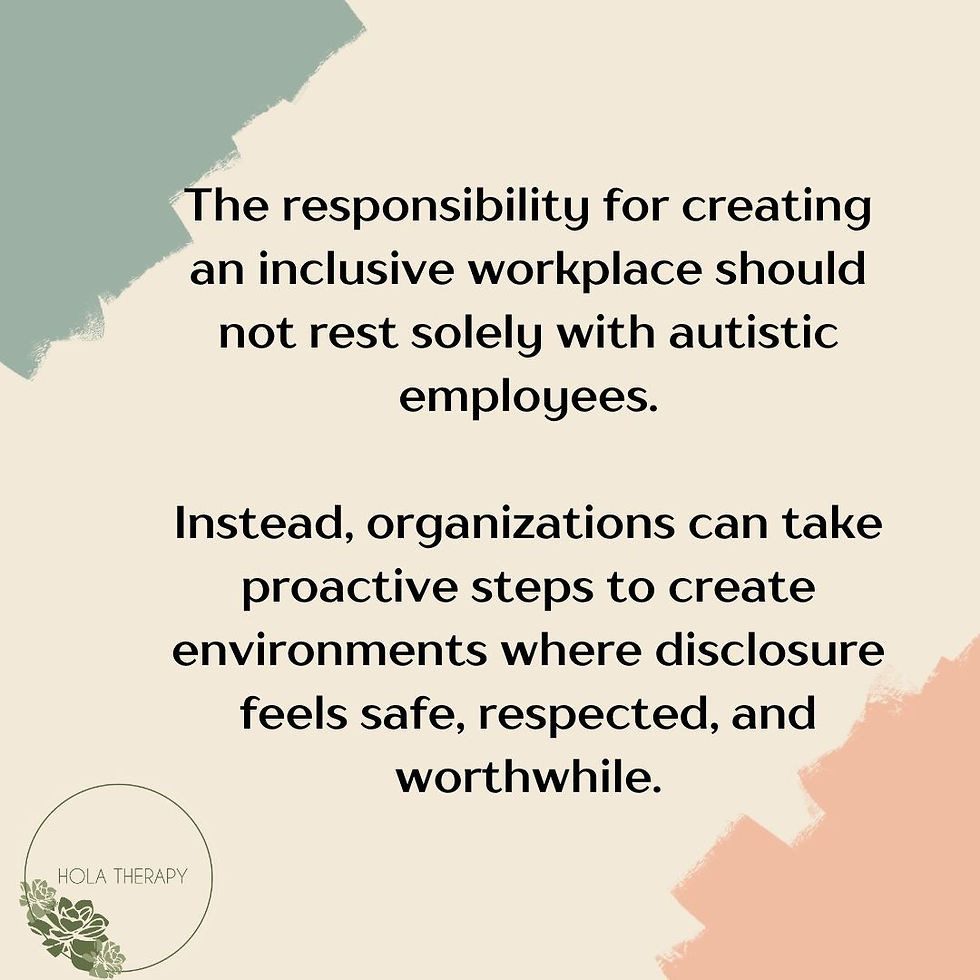
What can organizations do to make disclosure safer and more beneficial?
Creating a Neuroinclusive Workplace
Organizations committed to neurodiversity and inclusion can take several practical steps:
1. Create Clear Disclosure Pathways
Employees should know:
Who they can speak to
What information will remain confidential
What support is available following disclosure
Uncertainty often prevents people from seeking help.
2. Invest in Autism Awareness Training
Managers and colleagues may have limited understanding of autism, particularly when it presents differently across individuals.
Organization-wide training can help:
Reduce stigma
Challenge stereotypes
Improve communication
Increase confidence when supporting neurodivergent colleagues
3. Focus on Individual Strengths and Needs
There is no single autistic experience.
Rather than relying on assumptions, managers should have collaborative conversations about:
Communication preferences
Sensory considerations
Work environment needs
Strengths and challenges
4. Build Psychological Safety
Employees are more likely to disclose when they believe they will be treated fairly and respectfully.
Psychological safety benefits not only autistic employees, but entire teams by encouraging openness, innovation, and authentic communication.
Neurodiversity as a Business Advantage
Organizations that embrace neurodiversity are increasingly recognising the benefits of diverse ways of thinking, problem-solving, and processing information.
Inclusive workplaces are often better positioned to:
Attract and retain talent
Improve employee engagement
Foster innovation
Strengthen team performance
Enhance workplace culture
Creating a neuroinclusive workplace is not simply a compliance exercise. It is an investment in people, culture, and organizational success.
Jenna Mayhew is an Australian psychologist based in Mexico City and the founder of Hola

Therapy, a multicultural psychology practice serving international professionals, expatriates, and diverse workplaces. Jenna delivers corporate talks, keynote presentations, and workplace training on neurodiversity in the workplace, autism inclusion, psychological safety, inclusive leadership, and communication in high-performing global teams.
Drawing on over 20 years of experience across Australia, the United Kingdom, and Mexico, Jenna helps organizations understand how neurodiversity and cultural diversity intersect, and how inclusive communication can improve collaboration, employee wellbeing, retention, and performance in multinational workplaces.
To enquire about a corporate speaking engagement, workshop, leadership event, or DEI initiative, contact Jenna at jenna@holatherapy.mx.
Reference
Romualdez, A. M., Heasman, B., Walker, Z., & Davies, J. (2021). “People might understand me better”: Diagnostic disclosure experiences of autistic individuals in the workplace. Autism in Adulthood, 3(2), 145–156. https://doi.org/10.1089/aut.2020.0063


Comments